Chapter 1: The Living Flame |
||
|
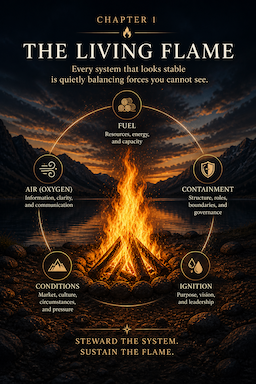
Every system that looks stable is quietly balancing forces you cannot see. You are invited to step away from the language of business and observe something more fundamental: the fire you have built. What appears strong on the surface is sustained by a fragile balance of fuel, oxygen, containment, and environment. The chapter reframes your organization as a living system, not a collection of tasks, revealing how growth and fragility emerge from the same forces. You will begin to see your organization differently, not as something to push harder, but something to understand more clearly. This shift in perception becomes the foundation for everything that follows. |
|
|
Chapter 1 Subsections: |
|
|
Chapter 2: The Illusion Beneath the Flame |
||
|
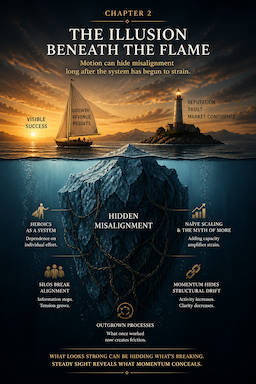
Motion can hide misalignment long after the system has begun to strain. This chapter exposes the quiet trap of momentum. Growth, activity, and output create the appearance of strength, even as structure falls behind. You see how heroics become embedded behavior, how scaling without redesign multiplies strain, and how silos and outdated processes fracture alignment beneath visible success. You will learn to distinguish motion from health and recognize when effort is compensating for design. This clarity allows you to stop reinforcing fragility through growth that looks like progress. |
|
|
Chapter 2 Subsections: |
|
|
Chapter 3: Erosion Beneath the Flame |
||
|
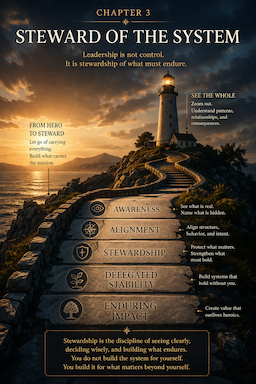
Systems rarely break suddenly. They erode quietly until the structure can no longer hold. This chapter traces how fragility accumulates beneath stability. What appears steady begins to leak energy, trust, and clarity over time. You see how fatigue, misalignment, and subtle inefficiencies compound into systemic strain, eventually shifting leadership from strategy to survival without a clear moment of failure. You will develop sensitivity to early signals of erosion before they become visible problems. This awareness allows you to intervene with understanding rather than urgency. |
|
|
Chapter 3 Subsections: |
|
|
Chapter 4: The Moment of True Sight – Entering the Matrix |
||

|
The system does not change when you see it clearly—but your leadership does. This is the turning point. You step back from motion and begin to see the structure beneath it. The Matrix becomes a lens that reveals patterns, relationships, and tensions that were always present but never fully visible. The shift is not tactical—it is perceptual, moving you from reaction to awareness. You gain a new way of seeing that turns confusion into pattern and pressure into signal. This clarity allows you to lead with steadiness instead of constant intervention. |
|
|
Chapter 4 Subsections: |
|
|
Chapter 5: The Disciplines of Constraint and Restraint |
||
|
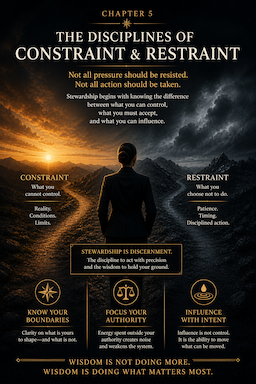
Not all pressure should be resisted, and not all action should be taken. You are introduced to the boundaries that govern every system: what can be controlled, what must be accepted, and what can be influenced. The distinction between constraint and restraint becomes critical, shaping where effort is applied and where it is conserved. Misunderstanding these boundaries creates noise, strain, and wasted energy. You will gain clarity on where your authority truly exists and where it does not. This allows you to act with precision, preserving energy and restoring balance instead of amplifying instability. |
|
|
Chapter 5 Subsections: |
|
|
Chapter 6: The System Reveals Its Shape |
||
|
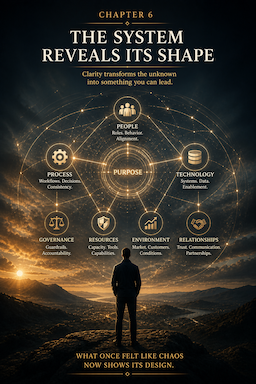
Clarity begins when you stop looking for answers and start reading the system. The system becomes visible as an interconnected architecture of people, process, and technology. You move beyond seeing into reading and understanding, tracing how decisions, information, and pressure flow through the organization. Patterns of delay, overload, and misalignment begin to reveal their underlying causes. You will learn how to interpret system behavior without distortion, allowing you to understand not just what is happening, but why it happens. This is the foundation for meaningful structural change. |
|
|
Chapter 6 Subsections: |
|
|
Chapter 7: The System Reveals Its Depth |
||
|
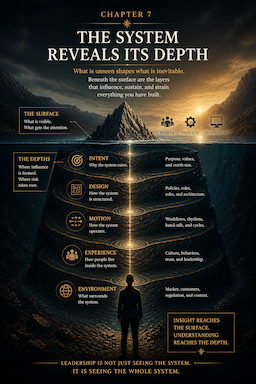
What you see on the surface is only a fraction of what shapes the outcome. The system unfolds beyond its visible structure into layered depth. Beneath people, process, and technology lies intent, design, motion, experience, and environment—each operating at its own rhythm while influencing the whole. What once appeared as isolated issues begins to reveal itself as interconnected strain moving across layers. You will learn to see beyond symptoms and into the deeper architecture shaping them. This allows you to locate where fragility originates, not just where it appears. |
|
|
Chapter 7 Subsections: |
|
|
Chapter 8: The System Reveals Its Boundaries |
||
|
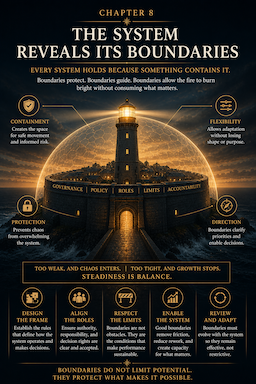
Every system holds because something contains it. You begin to see the frame that gives the system shape. Governance, policy, and boundaries are no longer abstract—they are the containment that allows energy to move without chaos. The chapter explores how systems fail when containment is too weak or too rigid, and how balance between structure and flexibility determines endurance. You will understand how to recognize whether your system is under-contained or over-contained. This clarity allows you to restore movement without sacrificing stability. |
|
|
Chapter 8 Subsections: |
|
|
Chapter 9: Stewardship – Leadership by Systems Empathy |
||
|
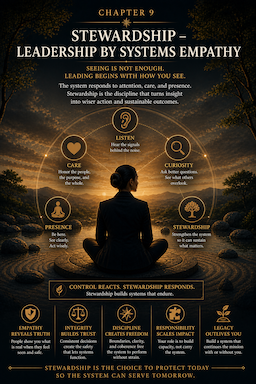
The system responds more to how you see it than how you try to control it. Leadership shifts fully from control to stewardship. The system is no longer something to direct through force, but something to understand through attention. Listening, care, curiosity, and presence become the disciplines that reveal truth before breakdown. You will learn how to interpret the system through awareness rather than urgency. This steadiness allows you to respond with precision instead of reacting to pressure. |
|
|
Chapter 9 Subsections: |
|
|
Chapter 10: The FCC Explained – The Architecture Behind Stability and Maturity |
||
|
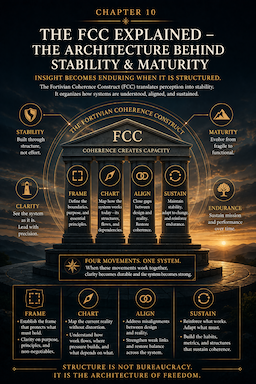
Clarity becomes durable when it is structured. Insight alone is not enough. This chapter introduces the Fortivian Coherence Construct (FCC), a structured framework that translates perception into stability. It organizes how systems are understood, aligned, and sustained through four interconnected movements. You will gain a repeatable way to interpret and strengthen your system. This shifts clarity from a moment of insight into a sustained capability. |
|
|
Chapter 10 Subsections: |
|
|
Chapter 11: Putting the FCC into Action |
||
|
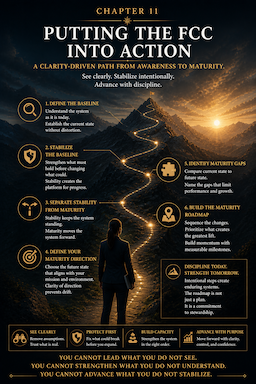
A system cannot be strengthened until it is seen as it is. You move from understanding to application. The system is observed without distortion, stabilized at its current state, and then guided toward maturity. The chapter emphasizes disciplined progression—resisting the urge to fix everything at once and instead reinforcing what must hold first. You will learn how to move from awareness to structured action without amplifying fragility. This allows change to strengthen the system instead of destabilizing it. |
|
|
Chapter 11 Subsections: |
|
|
Chapter 12: Enduring Systems – Stability, Innovation, and Adaptive Confidence |
||
|
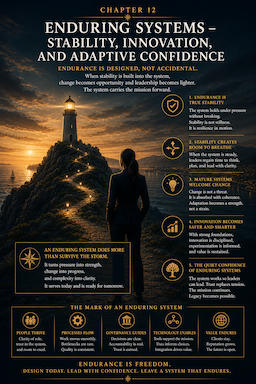
Endurance is not built through effort. It is built through design. The system reaches a state where stability no longer depends on constant intervention. Pressure no longer creates chaos—it moves through the system with coherence. Innovation becomes possible without destabilization, and leadership shifts from vigilance to trust in the structure itself. You will understand what true system endurance feels like and how it is sustained. This clarity allows you to lead without carrying the full weight of the system alone. |
|
|
Chapter 12 Subsections: |
|
|